




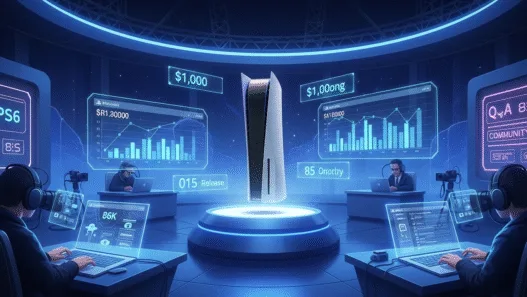

Sony has been working on PS6, its next-generation console, for about three years. Over the past few months there have been a lot of leaks about this console that have given us a lot of information about its specifications and also about other important details, such as its possible release date and its sale price.
Table of Contents
Last July we shared with you a special dedicated to PS6 where we reviewed ten things we know about this console thanks to those leaks, and today we have given shape to a new article in the form of questions and answers, where we are going to answer the most frequent doubts you have about this console.
If after finishing reading this article you have any questions, you can leave them in the comments and we will help you solve them. Should important new information emerge, we will update this article with new questions, as long as they are relevant and add value.
1. When will Sony launch the PS6?
Sony has not yet confirmed an official release date, but the launch of this new console is expected to occur between the end of 2027 and 2028. The date will depend on what Microsoft does with Xbox Next, a console that could arrive in 2027.
If Sony releases PS6 in 2027, it will have to coexist for a minimum of three more years with PS5 and PS5 Pro, which means that we will be facing one of the longest and most complicated generational transitions in console history.
2. What will PS6 cost?
We also don’t have official data, but the latest information we’ve seen says that it will be cheaper than the PS5 Pro. This console was launched with a price of $699.99 in the United States and 799.99 euros in Spain, so we have a scale that allows us to intuit where the shots will go.
I think the PS6 will most likely hit the market with a price of $599.99, which should become €599.99 in Spain, taxes included. Sony has always been committed to that parity, and it would be the most logical thing to do if the strength of the euro against the dollar is maintained.
3. Will it be compatible with PS5? And with PS4?
Yes, it is something we can take for granted. Sony already realized with the launch of PS5 how important it was to maintain backward compatibility with PS4 and had to back down and implement it so as not to be at a disadvantage against Xbox Series S and Xbox Series X.
With PS6 we can expect full backward compatibility with PS5 and also PS4. This will improve the value of the console and make it easier for users of those two consoles to transition to the new generation, which will also be beneficial for Sony.
4. How powerful will PS6 be?
It is something that is not yet confirmed, but the first information says that:
- It will be up to three times more powerful than the PS5 in rasterization.
- It will have 5 to 10 times more power than the PS5 in ray tracing.
Those are theoretical figures that we should not interpret as a direct equivalence of real power in games. The real technical improvement in games is going to be lower than those figures, as it already happened in the transition from PS4 to PS5.
Its theoretical maximum power in FP32 would reach 18.43 TFLOPs, a figure that could increase if Sony decides to increase the GPU’s working speed.
5. What technical improvements will it offer compared to PS5?
The differences between the two consoles are going to be very important, because PS6 is going to be a next-generation console that will bring a deep renovation of components and architectures. Although the information we have is still limited, these are the most relevant ones we know for now:
- CPU: jump from Zen 2 architecture to Zen 6. More frequency and performance, with the same number of cores and threads (8 and 16).
- Memory: it will continue to be unified. Goes up from 16 GB to 24 GB. Switching from GDDR6 at 14 Gbps to GDDR7 at 32 Gbps, the memory bus would drop from 256 bits to 192 bits.
- GPU: Move from RDNA 2 architecture to RDNA 5, also known as UDNA. Shaders increased from 2,304 to 3,072, more power and new technologies.
- SSD: faster and with a larger storage capacity in its base version.
6. Will PS6 be an 8K console?
It will have the ability to move content and games in 8K, but it won’t be able to run demanding games at that resolution without performance issues. PS6 is going to be a console to play in 4K with 60 FPS or 120 FPS, depending on the degree of demand of each game.
During the generational transition stage, where games will be developed for PS5 and PS6, the second generation will show better performance, but when the transition to the new generation is complete, it will have more problems because the games will be more demanding.
It’s the same thing that happened to the PS5, which was much looser with generational transition games and ended up rendering in 864p to rescale to 1440p in demanding games of its generation, such as Alan Wake 2 and Lords of the Fallen, among others.
7. What processor will PS6 have?
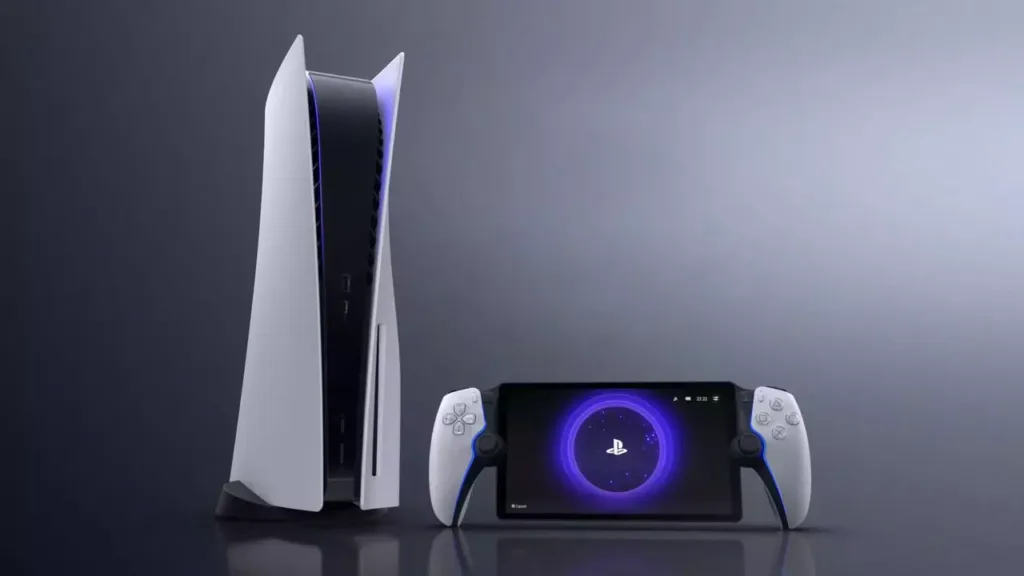
This console will use, according to the latest and most reliable rumors, a Zen 6 processor with 8 cores and 16 threads. Its full specifications have not been released, but this one could have 16 MB of L3 cache and 8 MB of L2 cache. Its working speed should also exceed 4 GHz, and it will be manufactured on TSMC’s 3 nm node.
If those changes in the processor are confirmed, the performance improvement compared to the PS5 CPU would be very large, because it uses the Zen 2 architecture and only has 8 MB of L3 cache and 4 MB of L2 cache (512 KB per core).
8. What GPU will PS6 have?
The most recent rumors say that it will be a graphics core based on the RDNA 5 architecture, which will have between 2,560 and 3,072 shaders, and that it will be manufactured on TSMC’s 3 nm node, a major improvement over the 7 nm node used by the GPU of the first PS5.
PS5 has a GPU based on the RDNA 2 architecture with 2,304 shaders. The difference may not seem like a big difference looking at the raw specs, but the number of shaders isn’t everything. PS4 Pro has a GPU with 2,304 shaders, the same as PS5, and yet the second one is much more powerful and advanced.
9. What new technologies will you use?
There has been a lot of talk about this issue, but we don’t have any concrete details yet. There’s one thing we can take for granted: the presence of hardware-accelerated intelligent upscaling. Sony may keep PSSR or opt for a name change to emphasize the novelty of PS6 versus PS5 Pro, but the base technology will be the same.
In addition to AI upscaling, there is speculation that the PS6 could feature AI frame generation and also other AI-based improvements, such as noise reduction for games that use ray tracing. In general, it is rumored that all of FSR Redstone’s technologies could come to Sony’s new console.
10. Will it have an optical drive?
It’s an important question, especially after the strategy Sony has followed with the current generation. PS5 hit the market in two versions, one with an optical drive and one without an optical drive. PS5 Pro is only available in a version without an optical drive, but you can add this one by purchasing it separately.
With that in mind, I think the PS6 will most likely hit the market in two versions, one with an optical drive and one without an optical drive. I do not rule out the possibility that it will only arrive in a version without an optical drive, and that this can be purchased separately as an option.
Be a part of over Success!
- Stay ahead of the curve with the latest tech trends, gadgets, and innovations! 🚀🔗Newsletter
- Follow me on Medium for more insights ⭐
- ✍️ Write for Us on Technoluting (Medium)
- 💬 Share your feedback or connect with me on LinkedIn — I’d love to hear from you!