





Explore our in-depth Noctua NF-A12x25 G2 Review with real-world temperature, airflow, and noise benchmarks to see how it performs under heavy workloads.
Table of Contents
Noctua is finally making its debut in the liquid cooling system market, and it does so only as it knows, through the front door, with the Noctua NL-LC1-48, Noctua NL-LC1-36, and Noctua NL-LC1-24, evaluating the latter two.
They present many new features with the aim of giving us the best performance and minimum noise generation, using the new Asetek Emma V2 pump with 3 layers of padding, Noctua NF-A12x25 G2 fans, a 30 mm radiator, and up to a 6-year warranty.
Before we go any further, we thank Noctua for trusting us and sending us this RL for analysis.
Unboxing
The Noctua NL-LC1 radiator series comes to us in a beautiful rigid cardboard box with the corporate colors white and brown, showing product information and images. Inside, we have a cardboard mold to store the components separately.
The content is as follows:
- Noctua NL-LC1-36 or Noctua NL-LC1-24 with NL-PNA1 noise absorber
- Metal plate with the Noctua logo
- 2 or 3 NF-A12x25 G2 PWM Fans
- 3 NA-AVG1 anti-vibration seals (pre-installed)
- 2-way or 3-way splitter cable NA-SC1
- 30 cm NA-EC1 extension cable
- Fan and radiator screws (Torx® T20)
- SecuFirm2+ mounting system for Intel and AMD
- Torx® Screwdriver T20 NM-SD1
- NT-H2 Thermal Paste
- Cleansing Wipe NA-CW1
- NA-TPG1 Thermal Paste Mold for AM5
- Noctua metal badge
System design and features
Noctua NL-LC1 makes a technical deployment in its first generation of liquid coolers to be placed directly in the high-end and premium with a focus on professional installations, without unnecessary lighting and aesthetic additions.
These systems are available in 3 formats: 420 mm, 360 mm, and 240 mm, and we will evaluate the performance of the last two, which are the ones supplied by the manufacturer.

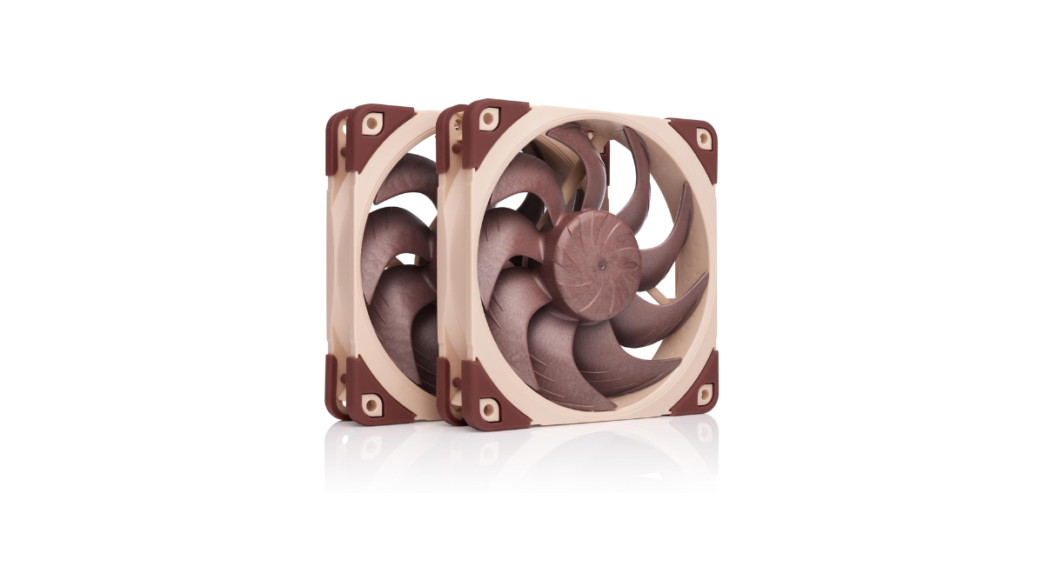
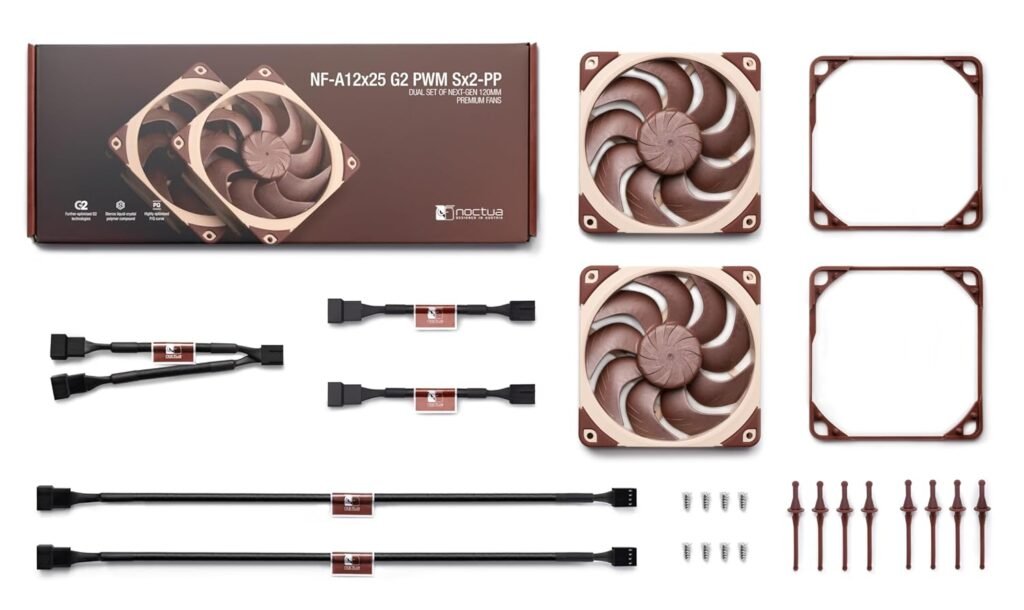
- Next-gen 120x25mm design for unprecedented quiet cooling performance in both high airflow and high static pressure appli…
- State-of-the-art engineering (Progressive Bend impeller with winglets and Centrifugal Turbulator, Flow Acceleration Chan…
- Dedicated push-pull set (Sx2-PP) with two NF-A12x25 G2 PWM 120x25mm fans that are slightly off-set in speed (+/- ~50rpm)…
Radiator and tubes
We began by studying the design of the radiator, which is built by Asetek in aluminum for the heat exchange zone and steel for the double-sided installation frames, using black for its coating.
This unit is 30 mm thick, 3 mm thicker than regular radiators, which will provide a higher volume of heat exchange than usual. We have 120 mm width and lengths of 400 mm for the Noctua NL-LC1-36 version and 280 mm for the Noctua NL-LC1-24.
The central area has 12 water conduits, 6 going and 6 returning as usual, joined by wavy fins with a density of 20 fins per inch, data supplied by the manufacturer.
The heat dissipation capacity measured by Noctua in NSPR is 248 units for the 360 mm version and 210 units for the 240 mm version. These are internal measurements of the brand comparable to the rest of its own dissipation solutions.
We see that the fluid distribution and return chambers are also covered by the outer steel chassis and in a square format, but we do not have a purge system or access to the fluid.
The water intakes are made of metal, introducing the rubber bands under pressure on them and applying plastic sleeves to hold the outer mesh. These tubes are made of EPDM (ethylene propylene diene monomer) with a length of 410 mm for the 360 mm version and 400 mm for the 240 mm version.
Their outer diameter is 12.5 mm and the inner diameter is 7 mm, and they are relatively rigid, although once they are heated by the fluid, they become more flexible.
The refrigerant that circulates through them consists of 22% propylene glycol and 78% water with anti-freeze, anti-corrosion, and harmless capacity, but it is electrically conductive.
Block and pump
In the RL Noctua NL-LC1, a great job has been done conscientiously to give us the best performance and noise suppression of the pump, choosing a top-generation platform such as the 8th generation Asetek Emma V2.
A 3-phase motor with ceramic bearings and a sleeve is used for it, working at a speed of between 750 and 3400 RPM maximum. The air injection system for the cold plate is centrifugal, injecting water evenly into the cold plate from the central area to the sides.
The cold plate itself is part of Astek’s construction, using a 99.95% pure CU1100 copper plate with perfect polishing of 55.5×55.5 mm and a slightly protruding round central area fixed by Torx screws. In the fluid area, it has microfins to ensure a greater heat evacuation surface.
Above the pump we have a noise-dampening system through 3 layers. A first layer of foam over the pump and, over it, a higher-density barrier, followed by a thicker layer of foam that is placed around the outer fairing and inserted into the fixing screws.
Even so, the pump is heard when it is above 2400 RPM as a result of the extremely quiet fans we have, although inside a chassis we do not hear it.
From the outside, you can see the first layer of foam, where the coolant tubes are fixed with wide swivel capacity to adjust the position on the base plate.
In this other area there is a switch that allows 3 performance profiles to be adopted by the pump, although in all of them it is possible to reach the maximum 3400 RPM:
- Quiet: limits the speed to 2100 RPM unless the fluid temperature exceeds 45ºC, where the pump will increase its performance to 3400 RPM.
- Balanced: The maximum speed is 2600 RPM until the liquid temperature exceeds 30ºC, activating the RPM curve again until the maximum.
- Manual: 3400 RPM is achieved regardless of liquid temperature.
This means that the Noctua NL-LC1 system internally monitors the temperature of the fluid to act according to the profile adopted, although we can ultimately adjust it from the BIOS itself. We don’t have control software.
The outer fairing is made of rigid plastic with a rounded aesthetic and matte black, leaving a gap in the center to magnetically fix either the brand’s flagship plate or the 80 mm Noctua NL-ACF1 VRM fan to cool the VRM, RAM, and SSD area.
Fans
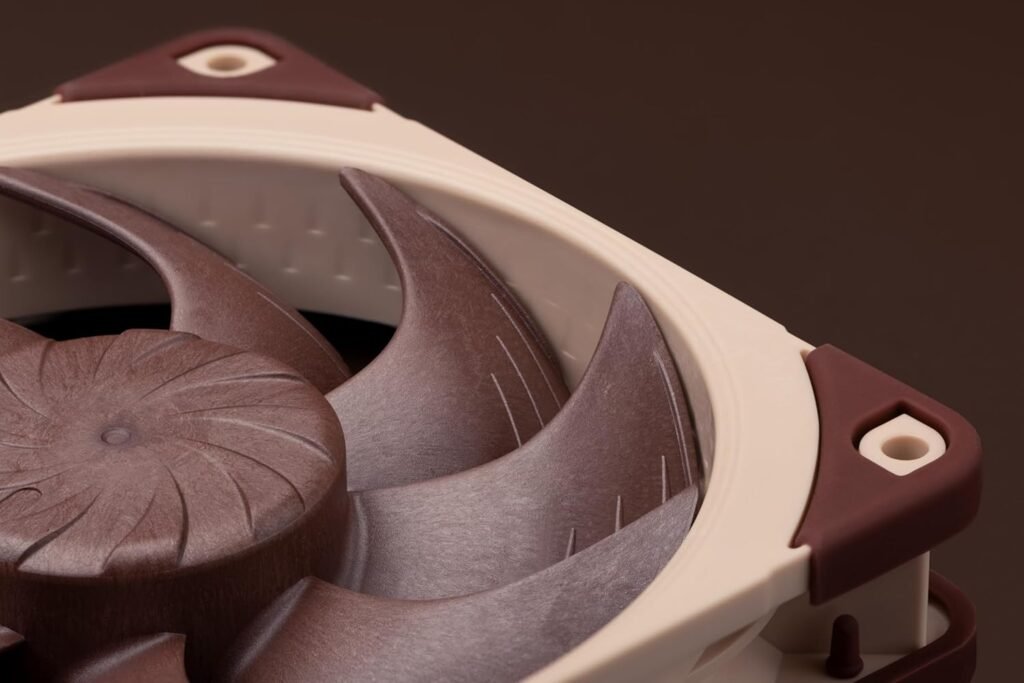
Next, we go on to analyze the fans of the Noctua NL-LC1, being the Noctua NF-A12x25 G2 PWM with PPA/PPB/PPA speed compensation; that is, the PPAs work at about 50 RPM less than the PPB to compensate for the location on the radiator.
Working at speeds of 1800 and 1850 RPM is compatible with PWM control thanks to its etaPERF motor with technologies such as Smooth Commutation Drive 2, which improves efficiency, or SupraTorque, so that the fans maintain their stable RPM regime when working under counterpressure, that is, when installed on a radiator.
These offer a static pressure of 3.14 mmH₂O, airflow of 63.15 CFM, and maximum noise of 22.5 dBA under ideal conditions, although at maximum manual performance they reach 44 dBA according to our tests.
As for the Noctua NL-ACF1 VRM fan, it is a standalone purchase unit, with an effective diameter of 80 mm, although it has a wider fairing, which is attached to the pump head by means of magnetic dots.
It has a height of 33 mm and a total width of 93 mm, weighs 95 g, and uses a 4-pin PWM cable that we can connect, for example, to CPU_OPT. It operates at a rate of 0 to 2200 RPM with a maximum noise of 17.7 dBA.
It generates a maximum airflow of 32.67 CFM and a static pressure of 2.37 mmH₂O and has a 6-year warranty, like liquid cooling.
Mounting
We proceed to assemble the two Noctua NL-LC1 systems that we analyzed; both work in exactly the same way, obviously.
For this purpose, the SecuFirm2+ fixing system is used, which consists of adapters in the form of plates for the most current Intel and AMD sockets, going from 4 anchors on the motherboard to 2 for the pumping block.
For this, lifting washers will be used that adjust the distance from the cold plate to the socket, both for Intel, where we must use the backplate provided by Noctua, and AMD, whose backplate is included in the motherboard.
We use AMD’s, which particularly has two positions separated by 7 mm to ensure compatibility with any board, whose plates we fix with Torx-head screws.
The pumping block already integrates the two screws with the same head as the previous ones and a pressure control spring, which we must tighten to the maximum without fear.
Finally, we connect the PWM header of the pump to AIO_PUMP and that of the fans to CPU_FAN, controlling these 2 or 3 at the same time.
Performance Testing
We evaluated the performance of the Noctua NL-LC1-36 and Noctua NL-LC1-24 by stressing an AMD Ryzen 7 9800X3D in stock settings (142W PPT), ECO mode 105W (125W PPT), and ECO mode 65W (83W PPT) mode. The ambient temperature is 24°C.
The test bench consists of the following:
| TEST BENCH | |
| Processor: | AMD Ryzen 7 9800X3D |
| Motherboard: | ASUS ROG X870E Crosshair Hero |
| Memoria RAM: | 32 GB G.Skill 6000 MT/s |
| Heatsink | Noctua NL-LC1 |
| Hard Drive | SSD NVMe |
| Graphics Card | Nvidia RTX 5080 |
| Power Supply | Corsair RM1000e |
The first test in stock configuration is the most demanding, reaching an average temperature of 80ºC for the 360 mm version and 84ºC for the 240 mm version, which are better figures than those obtained by the Corsair RL iCUE Titan.
The control of temperature peaks is excellent, only 1ºC for the 360 mm version, while the 240 mm remains at the same average figure, that is, at 84ºC.
In the second scenario, we reduce the performance to a TDP of 105 W with consumption at 125 W to deliver average figures of 74°C for the 360 mm radiator and 78°C for the 240 mm, again, with excellent control of temperature peaks, although the RL of the 240 mm is a little less effective.
This consumption is typical of what we can see in high-end CPUs with a multiplier locked in Intel and some AMDs.
Finally, with ECO mode at 65W and consumption at 83-84W, which is the equivalent of an AMD CPU with a locked multiplier, the figures are reduced to 56 and 58°C, respectively, with perfectly controlled temperature peaks.
It is surprising to see these two configurations so close despite having one less fan and shorter radiator, so they are excellent for high-end CPUs in both cases. We can afford to use the quiet or balanced profile of the pump.
Although for top-of-the-range CPUs such as the AMD R9 9950X or Intel U9 285K, whose stake at maximum performance practically reaches 300W, it is necessary to use the 360 or 420 mm version.
Noise
We added noise measurement using a sound level meter to evaluate the system at rest and under stress with the CPU in stock configuration in a controlled environment with noise of 30 dBA. Data collection is carried out at a distance of 50 cm from the test bench.
In this state, both RLs keep the fans away from their maximum RPMs; in fact, they barely reach 1100 RPM, so the behavior is quieter than when they are at maximum capacity.
This leaves us with figures of 32 dBA at idle without the chassis, with the pump being heard more than the fans when in manual mode, with figures of 42-43 dBA in both models.
VRM Fan Testing
We also added the temperature tests of the VRM zone of the board with and without the optional Noctua NL-ACF1 80mm fan.
Without a fan, we get a first state under stress with the stock CPU with 45.5ºC at the intersection of the two phase zones and 43.8ºC in the electric spur zone.
With a fan, the hottest area is now at the lower end with 39.6ºC, and where we used to have 43.8ºC, we now have 37.5ºC. We understand that the intersection drops below 39°C.
Therefore, the fan is totally effective in keeping the motherboard cooler, so in setups with very powerful CPUs and mid-range boards, it is more than recommended.
Final Words and Conclusion About the Noctua NL-LC1
For you it has been just over 5 minutes, but for us it has been a fairly long analysis, testing several CPU profiles and these two brand new RL AIOs from Noctua, a manufacturer to which we must always pay special attention for the quality of its products.
What we can say about its first line of liquid cooling is very positive. We used a new hardware configuration for testing, and it has already set the benchmark for performance above even an RL like Corsair’s 420mm Titan iCUE, a beast.
The 360mm RL is perfectly viable for top-of-the-line CPUs in PBO configuration, seeing what it does with the 9800X3D, with plenty of RPM headroom for its fans and, consequently, extremely quiet performance.
The 240 mm version also performs very well with this type of CPU with a 120W TDP; in fact, it is very close to the 360 mm version, although for top-of-the-range CPUs in PBO it will be fairer. It will be perfect for compact chassis and mid-range and high-end CPUs (not top-of-the-range).
It must be said that the tubes could be longer, since 400 and 410 mm are somewhat tight for large chassis.
Most of the key elements are made by Asetek: a 30 mm radiator a little thicker than average, a state-of-the-art pump, coolant, and tubes, all of a premium level quality for professional assemblies, without aesthetic additions such as RGB.
Noctua improves the proposal with 3 predefined performance modes for the pump by switch, 3-layer padding for the pump block, and a VRM fan that is quite noticeable in phase temperatures and electrical tracks.
For the choice of fans, they do not mess around and use the NF-A12x25 G2 PWM, the best of the brand in this format, with spectacular performance and very quietly even at maximum performance. These 3 fans alone are worth 100€.
The Noctua NL-LC1 series is positioned as a premium liquid cooling lineup, with the NL-LC1-24 priced at €220 (approximately $251 USD), the NL-LC1-36 at €250 (approximately $286 USD), and the flagship NL-LC1-42 at €280 (approximately $320 USD). Additionally, the optional Noctua NL-ACF1 fan is available separately for €20 (approximately $23 USD). These prices place the NL-LC1 series in the high-end AIO cooling segment, reflecting Noctua’s focus on premium performance, low noise, and long-term reliability.
We agree that these are quite high figures and typical of systems with a display and RGB, but in exchange we get fans and a state-of-the-art top RL circuit above average, and their performance endorses it, so they are more than recommended products for enthusiasts and Pro assemblies.
| ADVANTAGES | DISADVANTAGES |
| BUILD QUALITY | PRICE |
| NF-A12X25 G2 PWM FANS | NO CONTROL SOFTWARE |
| ASETEK CIRCUIT WITH IMPROVEMENTS BY NOCTUA | SOMEWHAT SHORT TUBES |
| EFFECTIVE VRM FAN | |
| HIGHLY EFFECTIVE ATTACHMENT SYSTEM SIMILAR TO ITS HEATSINKS |
FAQ from Content
Q1. What liquid cooling models has Noctua introduced?
A1. Noctua has introduced the NL-LC1-48, NL-LC1-36, and NL-LC1-24 liquid cooling systems, with the review focusing on the NL-LC1-36 and NL-LC1-24 models.
Q2. What pump is used in the Noctua NL-LC1 liquid coolers?
A2. The coolers use the new Asetek Emma V2 pump, which features three layers of padding to help reduce noise.
Q3. Which fans are included with the Noctua NL-LC1 series?
A3. The Noctua NL-LC1 series is equipped with Noctua NF-A12x25 G2 fans.