



Discover how Spotify’s new AI initiative with artists is shaping the future of music creation and transforming artist collaboration.
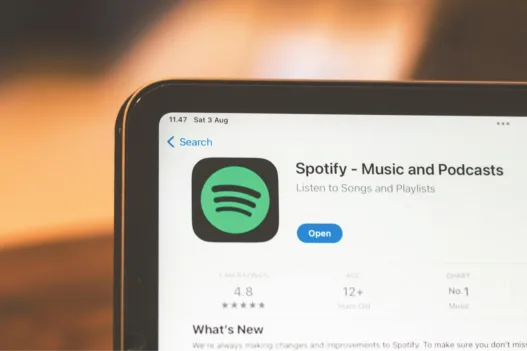
Every time a new technology bursts into art, the question is the same: can a machine create with the same soul as a human being? History shows that there are no simple answers. Artificial intelligence has entered the musical field with force and vertigo, generating synthetic voices, imitated songs, and complete productions in a matter of seconds. In this volatile context, Spotify has just announced “Artist-First AI Music,” an initiative with industrial ambition that aims, at least in theory, to put AI at the service of creators and not against them.
The proposal does not come alone. Spotify has partnered with the world’s leading record labels—Sony Music, Universal Music Group, Warner Music Group, Merlin, and Believe—to build AI-based music products that respect artists’ rights from conception. Unlike other more aggressive approaches, this project was born with a promise of control and collaboration: the tools developed will not be launched without first having licensing agreements with the rights holders. In the words of Daniel Ek, CEO of the platform, the goal is for “AI to amplify human expression, not supplant it.” 
This isn’t the first time Spotify has experimented with generative AI technologies. Features such as DJ, which offers personalized audio commentary, or AI Playlist, capable of creating playlists from written commands, already gave clues to the direction the company could take. What is new, however, is the intention to scale these capabilities through its own laboratories, specialized talent, and the necessary infrastructure to integrate AI deeply into the music experience. There is talk of creative assistants, mixing tools, voice editors, or generators of instrumental accompaniments, always from a logic of co-authorship.

One of the most delicate aspects of this commitment is the advance licensing system that Spotify is committed to applying. This means that prior to launching any AI product that involves the use of works, styles, or voices, direct authorization from rights holders will be required. In addition, artists will be able to decide whether or not they want to participate in this new environment. This policy seeks to avoid conflicts such as those experienced with songs generated from cloned voices without consent, an increasingly frequent phenomenon. By setting clear limits, the platform hopes to gain legitimacy in the face of a landscape of legal uncertainty.
But the debate goes beyond permits. What does it mean to create music in collaboration with a machine? Where is the uniqueness of a work if it can be replicated with a few lines of code? AI can be a powerful tool for expanding musical language, but it can also reduce it to predictable formulas if not used judiciously. Spotify, at least at this stage, seems aware of this shaky balance. His speech underlines the need to keep the human voice at the center of the process, although it is not yet clear how this “collaboration” between artist and algorithm will be measured, credited or remunerated.
In technical terms, the challenges are significant. Achieving models that produce quality music, with control over style, content, and context, is not trivial. Added to this is the need to avoid bias in training data, protect against accidental or deliberate plagiarism, and design accessible interfaces that do not replace the musician, but rather enhance him. It is also not resolved how this will impact the distribution of royalties, nor what measures Spotify will take to ensure transparency and traceability in each new piece generated with AI.
As a listener and as an observer, I find it impossible not to wonder if this evolution brings us closer to a new digital Renaissance or a simulacrum of creativity. Music, like any art form, is not defined only by the result, but by the process that originates it. We will see if Spotify and its partners are able to maintain that human dimension in an increasingly automated context. The future of music-making could depend on how we answer that question today.
Be a part of over Success!
- Stay ahead of the curve with the latest tech trends, gadgets, and innovations! Newsletter
- Follow me on Medium for more insights
- Write for Us on Technoluting (Medium)