






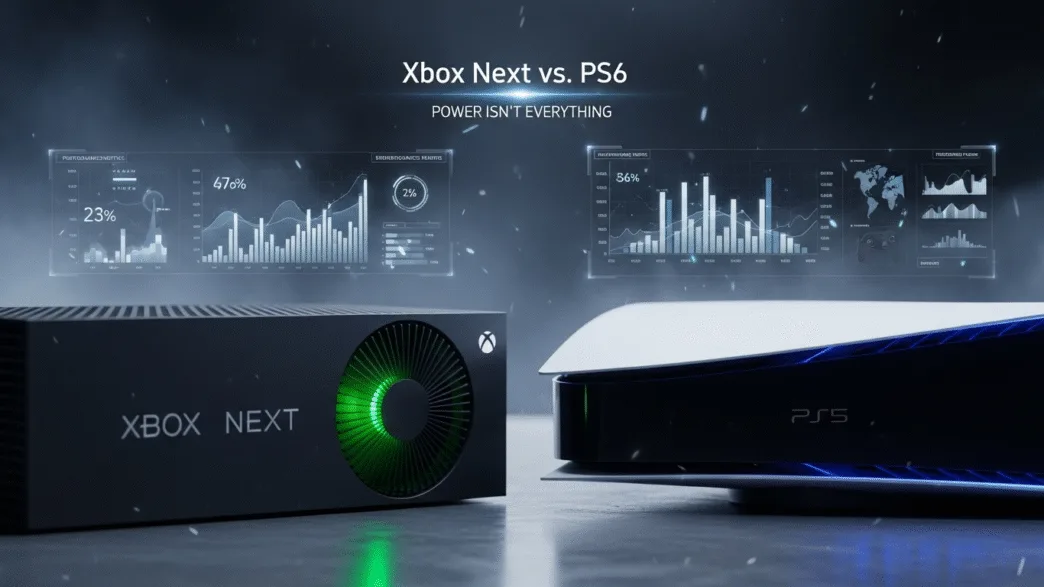
The PS6 and Xbox Next specifications have been leaked thanks to the internal documentation to which Moore’s Law is Dead has had access. According to those documents, both consoles will use a CPU based on the Zen 6 architecture and a GPU based on the RDNA 5 architecture, but at the same time they will be very different.
Table of Contents
PS6 is going to use an APU with a chiplet-type design. This means that the CPU and GPU will no longer share the same silicon chip and the same package, as was the case with the PS5. This APU will be smaller than the Xbox Next APU and therefore cheaper to produce. The size of the APU determines a significant part of the production cost of a console; a smaller size implies a lower cost.
Xbox Next will also use an APU with a multichip design, but this one will be much larger in size. CPU and GPU will each have their own package and will only share packaging. This design allows for the integration of more powerful processors and graphics cores, but at the cost of having a larger design that is much more expensive to produce.
Xbox Next vs PS6 specs comparison
According to the latest leaks, PS6 could hit the market with this hardware configuration:
- Multi-chip SoC manufactured on TSMC’s 3nm node with chiplet design.
- CPU with 8 Zen 6 cores at an unspecified speed, but it should be more than 4 GHz.
- RDNA 5 GPU with between 40 and 48 compute units, i.e., between 2,560 and 3,072 shaders at more than 3 GHz.
- 160-watt TBP.
- 160-bit or 192-bit bus with 32 Gbps GDDR7 memory.
- 24 GB or 32 GB of unified memory.
- 1TB or 2TB capacity SSD.
For its part, Xbox Next could be configured with the following components:
- Multi-chip SoC manufactured on TSMC’s 3nm node with chiplet design.
- CPU with 11 cores distributed as follows: three Zen 6 cores and eight Zen 6c cores.
- Zen 6 cores should run at more than 4 GHz, and Zen 6c cores should run at more than 3 GHz.
- RDNA 5 GPU with between 64 and 68 compute units, i.e., between 4,096 and 4,352 shaders at more than 3 GHz.
- TBP between 180 and 200 watts.
- 192-bit bus with GDDR7 memory at 32 Gbps.
- 24 GB or 32 GB of unified memory.
- 1TB or 2TB capacity SSD.
If these specs are confirmed, Xbox Next would have a CPU with more cores, but the Zen 6c core block would run at a lower speed, so its single-threaded performance would be lower. Its GPU would also be more powerful, as it would have many more shaders, but this does not guarantee that games will have more graphic quality or better performance.
Remember that the same thing happened with the current generation, Xbox Series X and PS5. The former has a GPU with 3,328 shaders, and the latter only has 2,304 shaders, but despite that big difference between the two, we haven’t seen current-gen games perform much better on Microsoft’s console.
I think this is because developers have opted for generational parity, something that greatly affected the first Xbox in cross-platform titles, which looked and worked almost the same as the PS2 versions, despite the fact that the first one was a much more powerful console. All in all, I’m surprised to see that no Microsoft exclusive has particularly stood out on Xbox Series X despite having a more powerful GPU.
Those are the two most important differences we see between the two consoles. The rest of the features will be very similar, and we don’t expect discrepancies in the amount of unified memory or in the storage unit, because they are two very basic components that in the end lay the foundations for development.
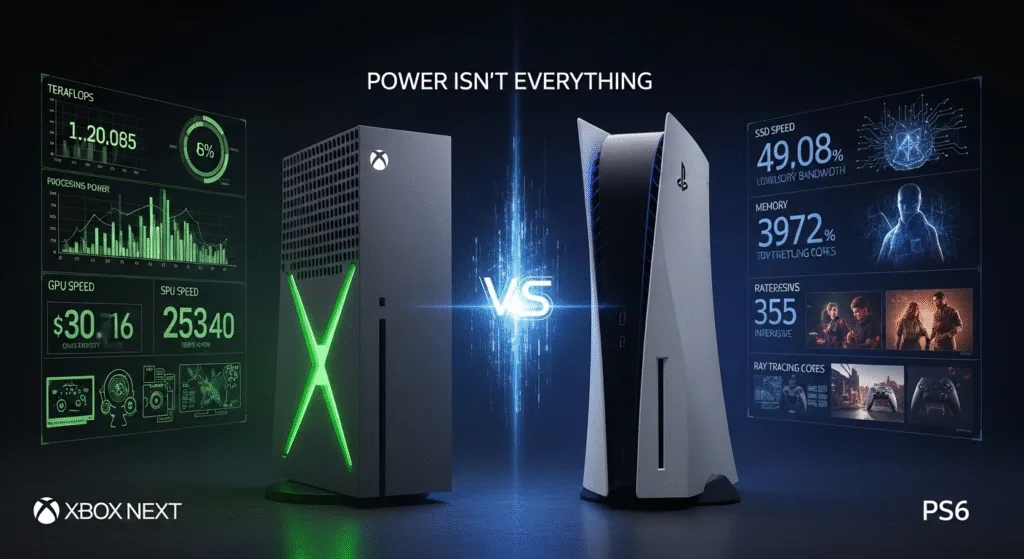
Which console will be more powerful, and what performance can we expect?
If we do the numbers with the PS6 and Xbox Next specs, it is clear that the second one is going to be more powerful, but this is not a guarantee of anything. Developers have become very lazy when it comes to optimizing and really taking advantage of the potential of the current hardware, and this is noticeable not only in the parity between Xbox Series X and PS5, but also in the terribly poorly optimized games that are coming to market.
Xbox Next will have, in the best case, a power of 26.11 TFLOPs in FP32, while PS6 will have a maximum power of 18.43 TFLOPs in FP32. The difference between the two would be almost 8 TFLOPs, a figure that could place them practically in different generations, and that would give Microsoft an advantage, provided that developers want, and can, take advantage of that extra power.
Comparing with current graphics cards and limiting ourselves to the values of each one in TFLOPs under simple precision, we see that the Xbox Next GPU would be positioned below the GeForce RTX 5070, which has a raw power of 30.87 TFLOPs in FP32. The PS6 GPU would be almost at the same level as the Radeon RX 7800 XT, which reaches 18.72 TFLOPs in FP32.
This doesn’t mean that its gaming performance will be directly equivalent to those graphics cards, because FP32 performance doesn’t directly determine gaming performance. For example, the GeForce RTX 5070 has almost the same level of FP32 TFLOPs as the GeForce RTX 4070 but performs 10% to 15% better in games.
All in all, those rough equivalences give us an idea of the performance we can expect. Both PS6 and Xbox Next should be able to run current-gen games in native 4K with at least 60 FPS, but I don’t think they’re going to be able to get to that level with next-gen games.
This is something that we already saw in the current generation. Remember the rumors that said that PS5 and Xbox Series X were going to be able to run games in 4K and 120 FPS? In the end, this has not been fulfilled at all; in fact, they are not even 4K consoles at 30 FPS. The most demanding games have ended up running in a resolution below 1080p and then upscaling to 1440p or 4K. I’ll give you an example: Alan Wake 2 renders at 864p and then upscales to 4K on PS5 Pro.
We need to talk about a very important topic, the possible performance in ray tracing. I’ve seen some pretty crazy rumors, such as that PS6 is going to outperform a GeForce RTX 5080 in ray tracing. It was also said that PS5 Pro was going to have much higher ray tracing than PS5, and that it would be closer to the GeForce RTX 40, and in the end it was all a lie.
Again, another example is Alan Wake 2 on PS5 Pro, which only uses ray tracing applied to reflections and with a lower quality level than low-quality mode on PC. By this I mean that we must take these rumors very carefully and not create expectations that are not at all reasonable.
PS6 and Xbox Next will offer superior performance working with ray tracing; that’s logical, because they’re a new generation of consoles, but this doesn’t mean that we’re going to see such a huge generational leap that comparing them to a graphics card right now costs more than 1,401.24 United States Dollar.
Some more realistic leaks say that PS6 and Xbox Next will perform 3-5 times better than ray-traced PS5 and Xbox Series X. If this is true, we could finally see games with ray tracing applied simultaneously to lighting, shadows, and reflections on console, and not limited to just one of those elements, as is the case with the current generation.
FAQ from Content
Q1. Which console is expected to be more powerful, Xbox Next or PS6?
A1. Based on leaked specs, Xbox Next will be more powerful with up to 26.11 TFLOPs compared to PS6’s 18.43 TFLOPs, mainly due to a larger GPU and more CPU cores.
Q2. What are the main CPU differences between PS6 and Xbox Next?
A2. PS6 will use 8 Zen 6 cores above 4 GHz, while Xbox Next will feature 11 cores (3 Zen 6 above 4 GHz + 8 Zen 6c above 3 GHz). Xbox has more cores, but PS6 cores are faster per thread.
Be a part of over Success!
- Stay ahead of the curve with the latest tech trends, gadgets, and innovations! Newsletter
- Follow me on Medium for more insights
- Write for Us on Technoluting (Medium)
- Share your feedback or connect with me on LinkedIn — I’d love to hear from you!